


A close that's vanished

Updated: Apr 27

Now that we've re-created Parliament Square we can explore some of its surroundings. There's a really intriguing close beside St Giles...
And in this blog we're going to see some dramatic reconstructions of it.

A close is the Scottish name for a passageway between buildings, which sometimes widens out into a courtyard. The passage can also be called a vennel. The one we're interested in is a narrow gap (just right of centre above the Guard's head in the top picture) which starts between the end of Goldsmith's Hall and the south west steps into St Giles. The steps used to lead into what was known as the Tolbooth Kirk (marked 'D' on the plan below). Fortunately St Giles has been well documented, and in some cases detail has survived of its immediate neighbours. For instance 'The Plan of the City and Castle of EDINBURGH' by William Edgar in 1742 shows the layout of our close. It's the passageway which leads from Parliament Close to the Land Market, or Lawn Market, in the High Street. The Old Tolbooth at the top end of it is marked 'B'.

A plan of 'St Giles Previous to 1829' by Rev John Sims, engraved by William Douglas, shows that the adjoining buildings were connected to the building of St Giles at first floor level. (See below). The print shows that areas marked 'E' were the New Tolbooth. The New Tolbooth, situated approximately where part of the Signet Library now sits, was built around 1562 in response to Queen Mary’s demand that the Old Tolbooth should be demolished. However it seems that the New Tolbooth was then used for additional accommodation, rather than the requested replacement. When the new building was condemned in turn, the council functions and staff were transferred to the new Royal Exchange (now known as the Edinburgh City Chambers) and the New Tolbooth was demolished in 1811.

It's known that some related civic business was actually conducted within part of St Giles itself for a while. From 1562, when Queen Mary declared the Old Tolbooth to be so run down that she wanted it demolished, it seems that the Court of Session decamped from the dilapidated original Tolbooth and sat within the upper level of St Giles Cathedral! (BOEC Vol 14 'There is the Town Church, the whole width of the two western bays of which were at one time occupied by the Tolbooth on the ground floor and by the Law Courts on the floor above. At the south -west angle is seen the New Tolbooth, occupied on two floors in a similar manner for tolbooth and court purposes.' - Henry F. Kerr.)
So we know that our wee vennel had an archway leading under the New Tolbooth and that there was a right-angled turn once you went under the archway. For a public thoroughfare this must have been appallingly dark and hidden. The Town Guard were stationed nearby at the Old Tolbooth, but even so it seems a pretty insalubrious entrance to the precincts of the Scottish Parliament. According to the 'Kay' painting in the Museum of Edinburgh in the Canongate this vennel was even used for the formal processions for the opening and closing of Sessions of Parliament, so it must have been quite a huddle as the great and good of Scotland crammed their way through to Edinburgh's principal civic square.
We can see that there was a building of some sort with a bow front between the New Tolbooth (E) and Goldsmiths Hall (F). A couple of windows to the New Tolbooth are show on its east wall, so the bow-fronted building must have been single storey. This suggests it was a shop or tavern, similar in form to the Luckenbooths which nestled between the buttresses of St Giles. Fortunately we have a splendidly detailed plan dated 1806-1818, courtesy of Sir Daniel Wilson. The original is in the Library of the Society of Antiquaries, and was reproduced in Volume 14 of the Book of the Old Edinburgh Club. (1925) This shows in dotted lines all the luckenbooths which were built on to the walls of St. Giles. We have other illustrations of most of these, but this plan is all that remains to us of the booth in the vennel.

So finally we have the whole shape of the vennel, leading from Parliament Square to the Old Tolbooth. Just before we reach that desolate pile we pass George Heriot's house on the left, shown on the plan above. Jinglin' Geordie (1563-1624) was the goldsmith who enjoyed notable success in his own lifetime and endowed George Heriot's College. The northern part was his home, while 'St Giles Previous to 1829' shows that his shop was immediately next to this in the lane. Heriot's workshop survived almost two hundred years after Heriot's death. It was eventually demolished in 1809, two years before the New Tolbooth. And there inside were discovered his old lintel, forge, bellows and crucible. So let's see what this all might have looked like. We'll approach from Parliament Square...

There in the centre is one of the windows of the Council Chamber of the New Tolbooth. Now we can enter and have a look at the booths on both sides.
It's said that Indian Peter had a tavern in the vennel leading to the Tolbooth. The right hand booth is a bit small, but could the building on the left have been his pub? (His tale is one for another day!) As the light gets mistier and more atmospheric we can see a faint glimmer coming through the passageway...

If we emerge from the shadows without being mugged, this is the view which would greet us...

The Old Tolbooth is dead ahead (appropriately). We can see the pediment above the door which we've already discovered in the woods at Abbotsford. The west wall of St Giles is on our right - no entrance on that side in the 1700s. To our left is Jinglin' Geordie's shop and house. And to the right is the entrance to the Luckenbooths - which I'm still constructing!
A quick look back over our shoulder. There's somebody following us.
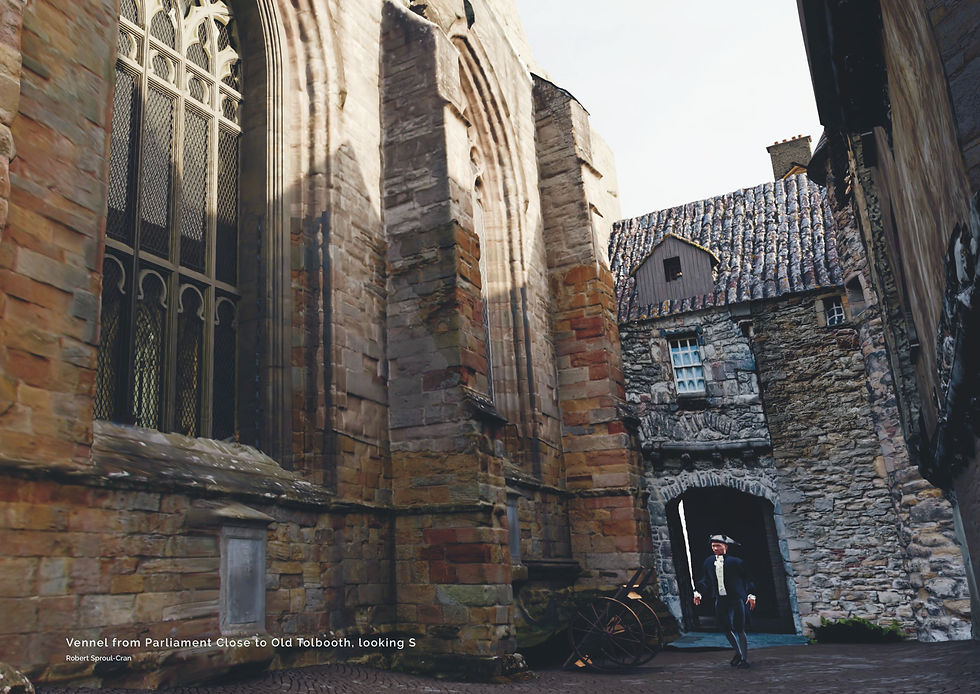
Once we get to the Tolbooth door we'll have a final glance to the left to make sure the Guard is on duty, and we've got a fighting chance to make it to the High Street unscathed...

More on the Old Tolbooth next time.
A final word - just to say that I took part in the Courts and Tribunals Service presentation at this year's Doors Open Day on Saturday 27th September 2025. I was in Parliament Hall with some of my virtual photos of the place in the 1700s and copies of the old prints and maps they're based on. People were queuing around Parliament Square to get in and book a tour! Many dropped by for a chat to hear more about the work, and see my re-creations of Parliament Hall in the actual place. Here are some pictures from the day...


Wonderful! I’ll have to take this up to St Giles on my phone and try to see it in situ.
Excellent & fascinating. As George Heriot Jnr left Edinburgh for London in 1603, perhaps his Father (George Heriot Snr - also a Goldsmith) occupied the House and Workshop until his death in 1610 ?