


Edinburgh's Old Tolbooth - back from the dead!


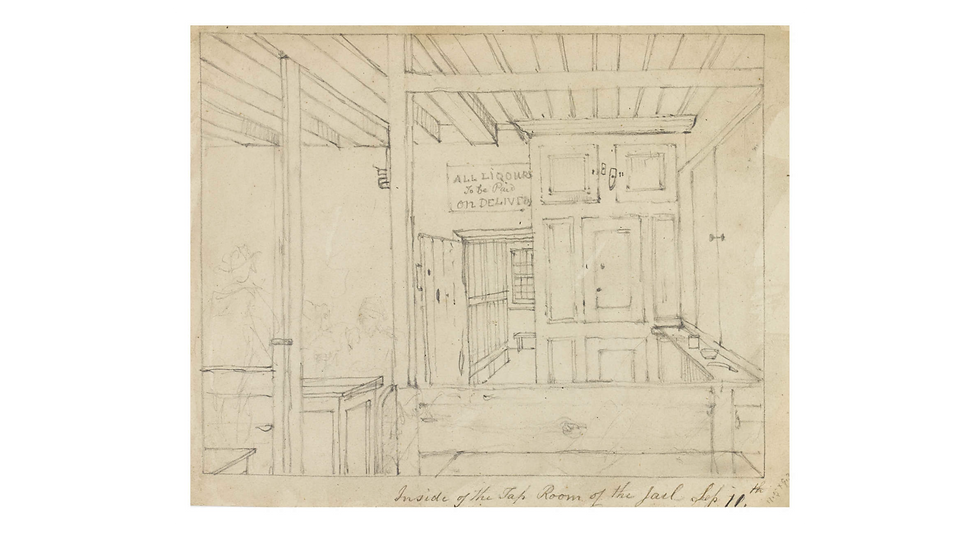
Here's the door through which generations of Scottish criminals, including Deacon Brodie, were taken to their doom. Let's follow the mob for a good look at this vile building. Because it was the site of public executions, wholesale torture and appalling suffering. It also had a butcher's shop facing the High Street, and a tap room for refreshments...
Tolbooths were sites of city administration in early Scotland, large public buildings or townhouses that did much of the work that modern councils now carry out. The Scottish Parliament would be based in the Tolbooth when it was sitting in Edinburgh, and the top civil court of Scotland, the Court of Session, would also make use of the Tolbooth for its hearings. The city magistrates and staff used the building, and on occasion it was also used by the functionaries of St Giles, next door. In addition, it soon became the city prison, which became its sole function after 1563.
The first Edinburgh city tolbooth to be recorded was in 1365, with King David II granting land for building a new tolbooth (so there must have been an earlier one too). This tolbooth burnt down not long after construction (possibly during an English invasion in 1385) but its replacement was built soon after in 1386. Its tower became dilapidated and was pulled down and rebuilt in 1500. This is the tower in the middle of the image above, with a reinforced door leading to a spiral staircase.
The city’s Old Tolbooth had become severely run down by the time Queen Mary encountered it upon taking up residence in Edinburgh in 1561. She quickly issued a letter to the town council, requiring them to take it down as soon as possible, while providing other accommodation for the courts.
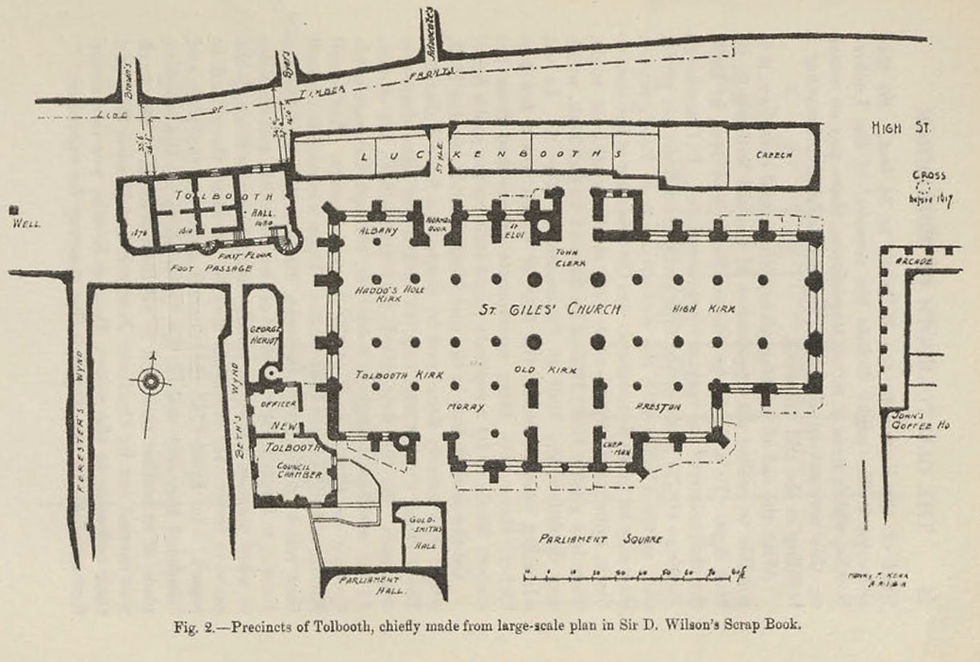
But by 1565 the Old Tolbooth was repaired rather than being demolished, with an initial 1610 addition on the western side and then a further 1678 half height extension on the side of that, originally built as shops for goldsmiths but later incorporated into the body of the prison. Let's head away from St Giles up the lane towards the High Street.
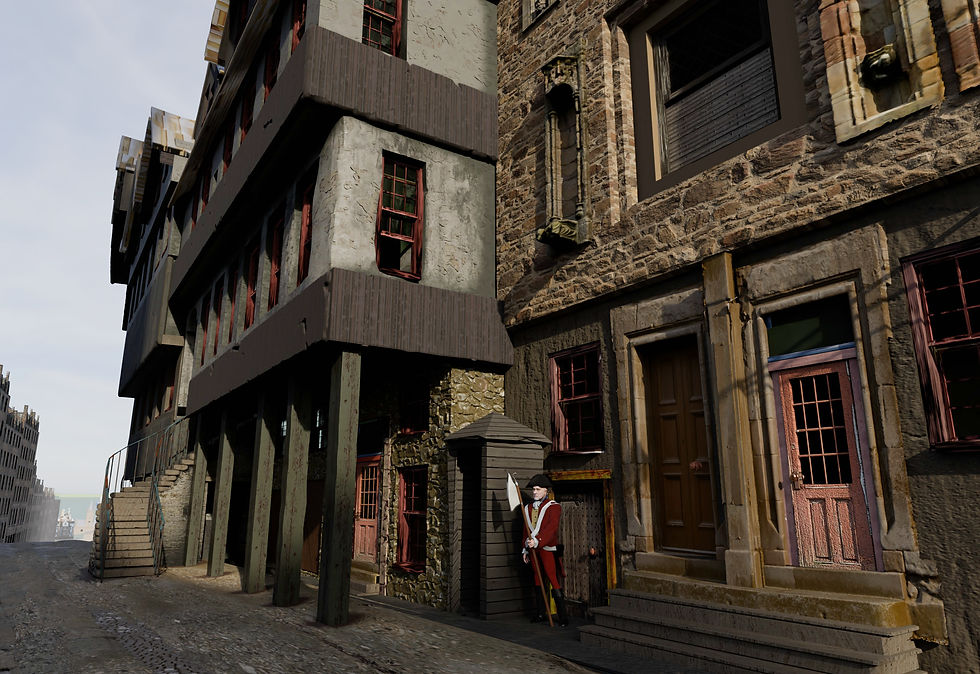
This is the view from a tenement window where a resident could have watched us walk (no doubt with a nervous shiver) past the Guard and up the narrow lane. But they'd have better entertainment than watching our arrival. Because the two story extension on the West side was used as the platform where city executions took place, with prisoners being brought through the building from their cell inside the central prison section. You can see the wooden beam projecting from the end of the building from which a rope would have been suspended. There's even a cross piece at the end, presumably so that two or three unfortunates could be strung up side by side. The Widescreen or Imax of its day.
Let's see the view the mob would have enjoyed.
That's really handy, to think that you could head into the shops below the scaffold to pick up a souvenir of the day. Unfortunately the original plan for the shops to be occupied by goldsmiths didn't last, although at one point there was a butcher's shop under the scaffold, so a least you could have got some pork chops under the bodies swinging in the Old Town breeze. Folk must have had stronger constitutions in those days. Because the Tolbooth was a notorious haunt not just for executions, but for wholesale torture too. The Maiden - the Edinburgh guillotine - was used nearby, but never as far as I can tell on the platform at the Tolbooth. However you wouldn't miss out, since the heads were often displayed there.
In 1787 the city guard was moved out of the guard house just down the High Street. This ramshackle building in the middle of the road was demolished and they moved into the extension on the side of the Old Tolbooth. So the retail businesses were closed down to provide a home for the forces of law and order. Now the Police Stations are being closed and turned into coffee houses again, so if you wait long enough...
Let's walk past the nearby Tolbooth Well to take in the view from there.
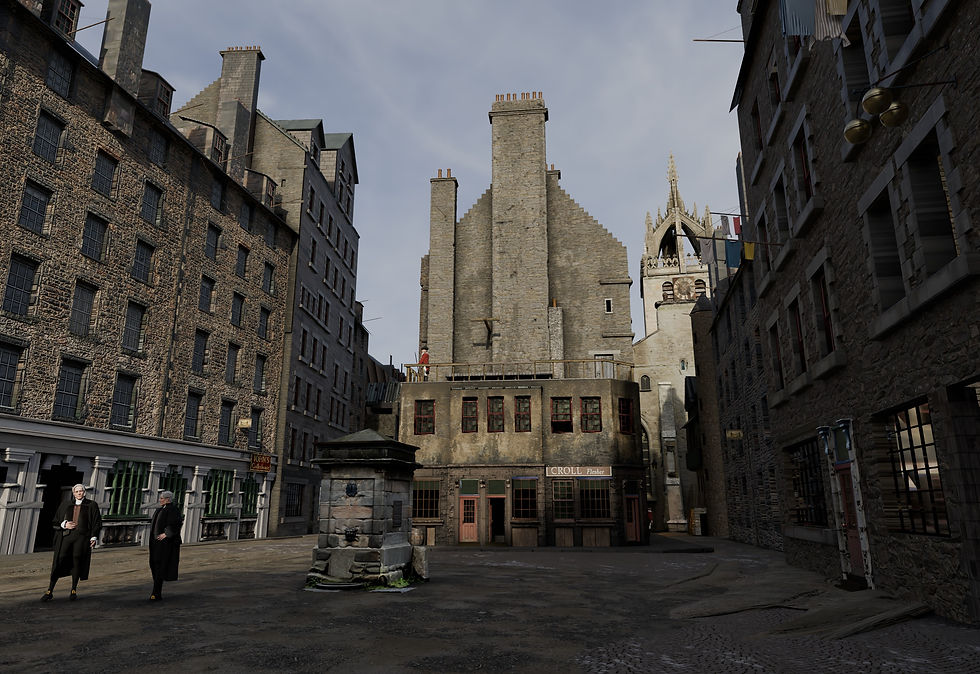
There were wells at intervals up the High Street. These would be a regular social meeting spot, since the houses wouldn't have had running water plumbed in. If you think tenement stairs are hard work (up to eleven in Edinburgh's case - the world's first skyscrapers!) then imagine having to make the ascent carrying all your drinking and washing water. Of course you could employ a water carrier to do it for you with a barrel on his back.
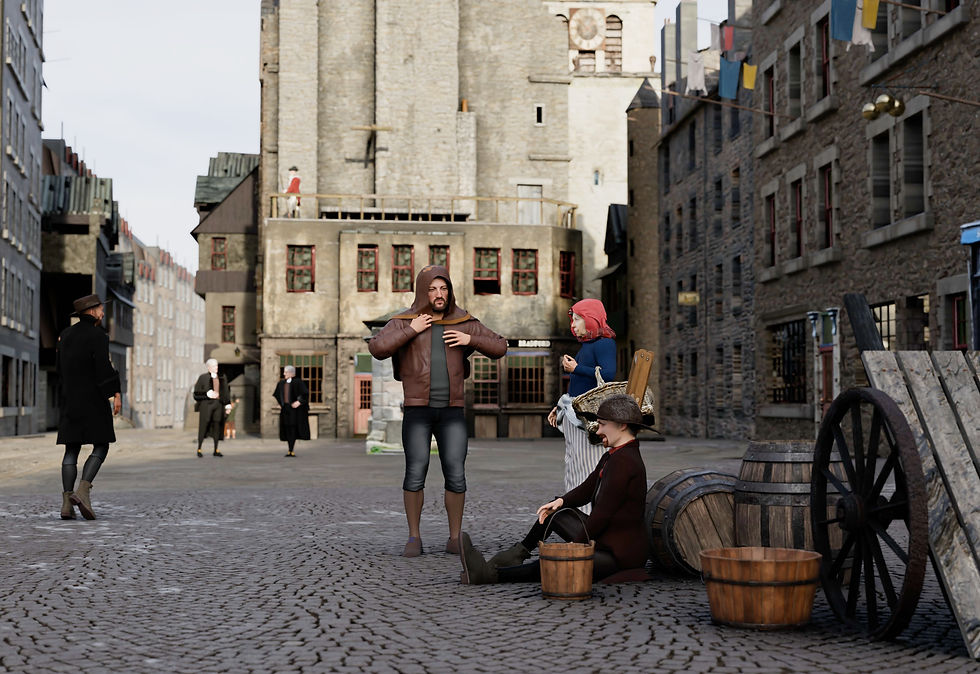
The Old Tolbooth became ever more run-down and unsuitable for city purposes. The city commissioned a report from the architect Robert Reid on the condition of the building, which he delivered to them in March 1808. His report was scathing, concluding with the statement that “it is difficult to conceive a building both from situation and internal construction so totally at variance with every principle on which a Gaol should be constructed and regulated with regard either to the health, morals, or security of the prisoners.”
The building limped on, until eventually the decision was made to demolish it in September 1817. One of the reasons given for the desire to remove it was that its position on the Royal Mile was severely congesting foot and other traffic in a busy part of the city. In addition, its condition was deplorable, and the newly completed Calton Prison was easily able to accommodate any miscreants the city produced.
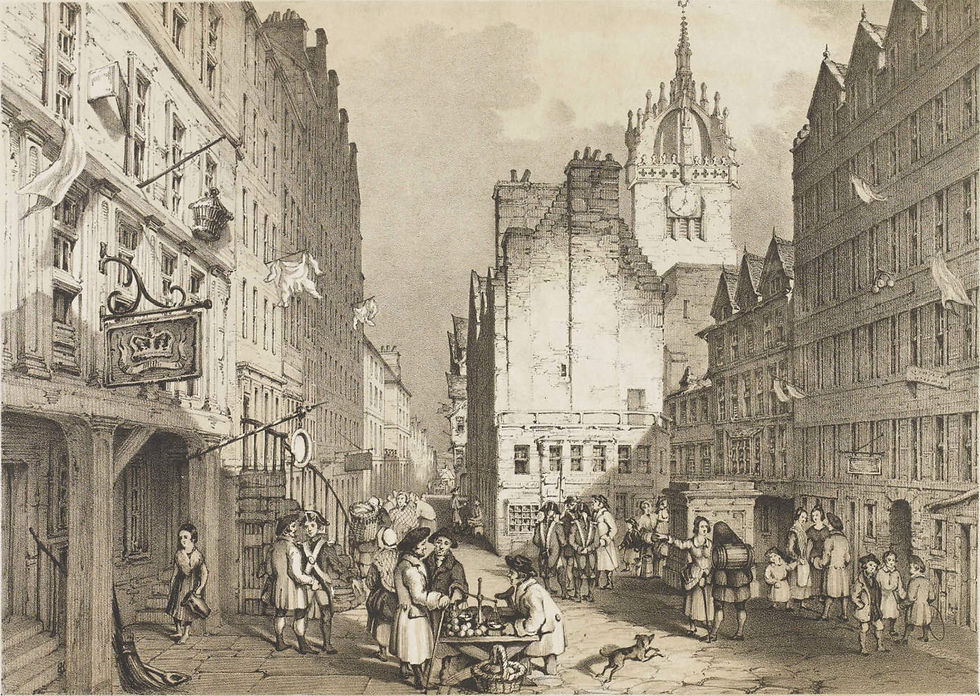
This image was engraved by W and A K Johnston in 1852, but shows an earlier scene. The artist appears to have rearranged the buildings subtly since it shouldn't be possible to see the tower of St Giles neatly framed to the right of the Tolbooth while still making out John Knox's house down the High Street.
This photo shows where you'd have to stand to try to achieve the same line-up. Brass studs set into the ground show where the Tolbooth stood. The statue near the centre of the picture is roughly in line with the right hand edge of the Tolbooth. If you moved over to the north side of the street (on the left) as in the print, the spire of St Giles would be hidden behind the Tolbooth.

But lets forgive the artistic licence (and thank the artist for recording so much detail for posterity). Now let's have a shot at recreating the scene from roughly where he intends it to be.
It's less crowded, but at least I've included a tourist - from the Highlands, judging by his kilt.
Finally, let's take a wander down the High Street to take a look at the North facade of the Tolbooth. According to contemporary accounts the road was only thirty four feet wide, with the gap between overhanging windows on each side of the street a mere sixteen feet.
You get a good idea below of the different phases of construction - the original 1500 stone tower, the 1610 building which was added, and the 1678 extension.
The strong Edinburgh afternoon sunshine shows up the masonry to fine effect...
And looking further down the High Street we can now just make out John Knox's house (or was it?) and the Netherbow Port - the entrance to Edinburgh through the city walls.
But that's an exploration for another day. To make sure you don't miss this, and a fascinating trip to the long vanished Luckenbooths behind the Tolbooth, make sure to subscribe at the foot of this page. Thanks for your interest!


A great set of images - thanks for sharing, Robert! Such an interesting way of opening up the history books and showing us how it would have looked. I can now visualise what I'm reading about.