


The Luckenbooths - a gem rediscovered

Updated: Apr 21

This time I'm going to show you a place which has been lost for three hundred years. Prepare to step back into the 1700s...
The Luckenbooths were lockable booths. Some nestled against the bulk of St Giles, tucked into the spaces between the medieval stone buttresses. There were two or three at the west end of the building beside the old Tolbooth, but most of them faced on to a narrow lane to the north of the church. Across this lane was a row of houses and Luckenbooths which ran parallel to St Giles half way across the High Street. The lane was cramped, smelly, and a legendary shopping experience! The only natural light would have percolated down through the smoky air from high above. The closest I can imagine would be an Arab souk.
There are several descriptions of the Luckenbooths, but I am not aware of any drawing or painting which shows what this lane was like - or more importantly, what the place felt like to visit and explore. So how is it feasible to attempt to reconstruct virtual photographs of this lost arcade of wonders?
Fortunately there are detailed records of the layout. Let's start with a couple of maps. Kincaid's map of 1784 shows the general geography. Here the 'Luckenbooths' describes the entire block from the Old Tolbooth on the left to Creech's Land at the right hand end - the shop and publishing house of William Creech. (Not named on this map.) The lane of stalls is labelled the 'Creams'. These were described elsewhere as the Krames. Crames, Craims or Kreims.

There are more detailed maps which allow us to zoom in closer.

Perhaps the most useful is one based on a hand-drawn plan drawn on site by Sir David Wilson. This has some precise measurements, which even show the extent to which the upper storeys in the High Street overhung the road below. According to the illustration below, at its narrowest point the High Street was only 16 feet 8 Inches, or just over five metres. You could easily have conducted a conversation with your neighbours across the street.
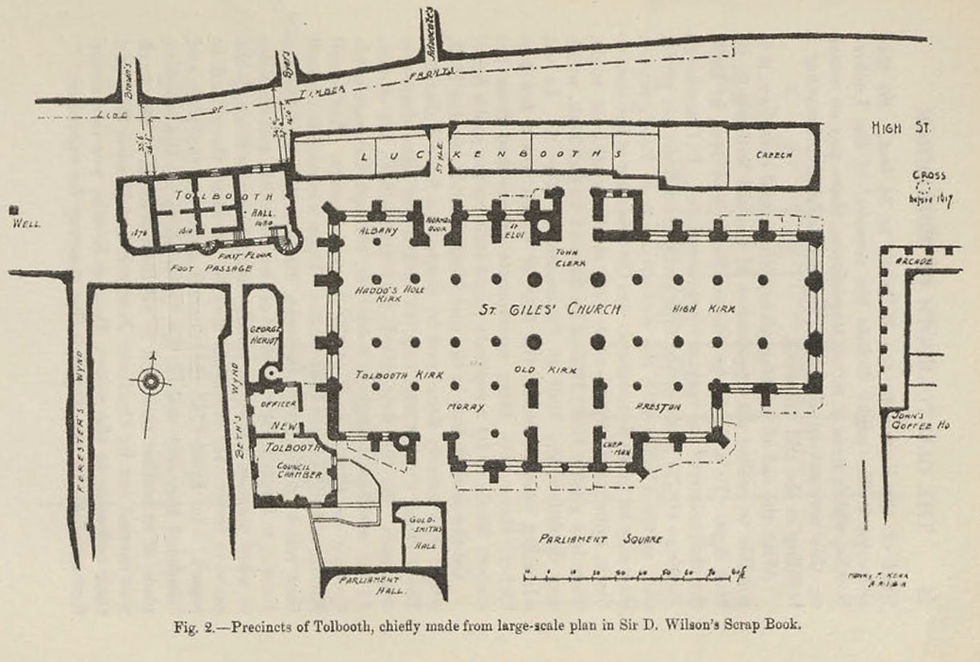
When the Luckenbooths were demolished and St Giles was clad in new facing stone the church was extended several feet to the north. Fortunately several diagrams and illustrations of the original facade still exist, and there are brass studs in the road to show where the buildings stood.

Originally the stone of St Giles would have been a warmer colour, similar to the Border Abbeys of Melrose, Dryburgh and Jedburgh. Today the Craigleith sandstone of the bulk of St Giles is a rather sombre grey. But to get a feel for the original appearance you just have to lift your eyes to the tower and spire. It was impractical to re-clad this wonderful piece of Gothic art, so it still stands in its original straw-coloured glory.

And yes, I did have to climb on to the roof of Parliament Hall to get that picture. Worth it!
So what do we know of the booths which lined this long-lost lane right in the heart of Edinburgh's Old Town? Fortunately there are some paintings and drawings of the Old Tolbooth and the North Side of St Giles which were made at the time that the Luckenbooth row and other tenements were being demolished. This was intended to open up the space around St Giles and the plot where the new Signet Library was to be built. Here's one which helps our detective work.

Some of this image is fanciful, as is the original painting. The Old Tolbooth's two roof ridges were of the same height, not staggered as shown here. The windows in the tenement on the High Street behind were more regular than the picturesque scattering in the picture. We know because the building still stands, above Advocate's Close. The medieval building on the left with a dramatic tower seems completely invented. All of the housing blocks which were demolished ran at right angles to the Tolbooth and the High Street - not artfully diagonal like this one. Check the Kincaid map at the top of this blog. This building seems to have been added to balance St Giles on the right and to frame the composition more pleasingly.
But there's part of the image which gives us an insight into the booths - details which are corroborated in other fragmentary images at the time they were being demolished. Let's take a closer look.

Two of the three booths have an upper storey - not one you could walk upright in, but more of a loft. This makes sense. The loft would provide additional storage, but would also allow the proprietor to sleep above the shop - pretty important if you had valuable stock on the premises. Two of the booths have window panes, while the left hand one is ambiguous. Contemporary descriptions suggest that once shutters were removed some of the booths would have been open to the elements, like a market stall.
Two of them have a counter or table in front to display the wares. You can see why. In the narrow Krames there must have been very little natural light reaching the interior. The table on the right hand booth might even have been made by hingeing the shutter down and supporting it on legs.
So now let's venture into the Krames, to soak in a visit to a place lost for over two hundred years. Our entrance is where the two women in the print are standing in the background, between the Old Tolbooth and St Giles...

We've reinstated Jinglin' Geordie's house on the left hand corner. And in the start of the Krames we can see a table laid out with merchandise and a candle lit to display it to advantage. With growing anticipation we walk up to see for ourselves.
In 'Heart of Midlothian' Sir Walter Scott describes a visit by Mr Butler, a schoolmaster, who follows this very route.
He stood now before the Gothic entrance of the ancient prison, which, as is well known to all men, rears its ancient front in the very middle of the High Street, forming, as it were, the termination to a huge pile of buildings called the Luckenbooths, which, for some inconceivable reason, our ancestors had jammed into the midst of the principal street of the town, leaving for passage a narrow street on the north; and on the south, into which the prison opens, a narrow crooked lane, winding betwixt the high and sombre walls of the Tolbooth and the adjacent houses on the one side, and the butresses and projections of the old Cathedral upon the other.

We enter past the Tolbooth door. Now we're looking down the lane to the east. The tall building right at the far end is the back of Creech's Land. We know that toy shops were a noted feature of the Luckenbooths - so let's have one of these on the right.

There are toy soldiers, hobby horses, carts and model ships. Leaning against the table is a metal hoop - part of a gird and cleek which could be birled down the road with a good old clatter. There's a doll's house and a doll, which Scott refers to as a 'baby'. The shopkeeper has had to light some candles to supplement the dim daylight, and in the background we can see a ladder to reach the loft.
In 'Heart of Midlothian' Sir Walter Scott describes the delights of the Luckenbooths:
To give some gaiety to this sombre passage (well known by the name of the Krames), a number of little booths, or shops, after the fashion of cobblers’ stalls, are plastered, as it were, against the Gothic projections and abutments, so that it seemed as if the traders had occupied with nests, bearing the same proportion to the building, every buttress and coign of vantage, as the martlett did in Macbeth’s Castle. Of later years these booths have degenerated into mere toy-shops, where the little loiterers chiefly interested in such wares are tempted to linger, enchanted by the rich display of hobby-horses, babies, and Dutch toys, arranged in artful and gay confusion; yet half-scared by the cross looks of the withered pantaloon, or spectacled old lady, by whom these tempting stores are watched and superintended. But, in the times we write of, the hosiers, the glovers, the hatters, the mercers, the milliners, and all who dealt in the miscellaneous wares now termed haberdasher’s goods, were to be found in this narrow alley.

As we make our way past, we can see the next booth is still partially shuttered. It's selling hats and general haberdashery. As we glance back we see that a competitor across the lane has more of the same.

Half way down the alley we come to the North Door into St Giles on our right. On the left hand side is a passageway through to the High Street. It is called the Stinking Style, for reasons which must be fairly obvious. When the Luckenbooths were first built in 1555 onwards the intention was that they should be businesses in keeping with their position around St Giles such as goldsmiths, silversmiths and bookshops. But by the 1700s they had gone down-market.

There were practical items on sale as well, such as pattens. These were like clogs or platform soles which could be tied or buckled on on top of your normal footwear. They raised you up out of the mud and muck in an attempt to make the streets passable. They were mainly, but not exclusively worn by women, and generally by the poorer folk. The more well-to-do might get by with hansom cabs and carriages - but having said that there are some examples of highly decorative pattens which fitted over matching, more delicate indoor shoes.

Some were rigid, while others had a leather hinge behind the ball of the foot. Many relied on the thickness of the wooden sole but more elaborate styles were raised up on a metal frame, like the one Jennie, our proprietor, is holding.

A little further down there's a silversmith, probably bemoaning the way the district has gone downhill. In future he'll probably have to turn out Luckenbooth rings to satisfy public demand.

Here we have a stroke of luck. When the Tolbooth was demolished in 1817 and the row of buildings known as the Luckenbooths was cleared away the north side of St Giles was once again visible from further back. Several drawings and watercolours were made which were then reproduced in books and prints. For a brief period the Luckenbooths attached to St Giles were visible. In one print they're shown boarded up and derelict, but in an illustration in the 1781 edition of 'The Scots Worthies' by John Howie (1735-93), published in 1879 as a colour lithograph, we can clearly see the booths at the east end of the Krames.

This allows us to complete our reconstruction with some confidence. Now we can have a good look at the east end of the passageway as it narrows on the way to Creech's Land.

And fingers crossed that's what we'll be looking at next time.


Fascinating, although I wonder if mentioning Hansom cabs is slightly anacronistic as they were only patented in 1834. The well-to-do probably avoided the notorious Edinburgh mud by taking a sedan chair as any wheeled conveyance would have been inconvenient in Edinburgh's closes.